Table
ImageColumn
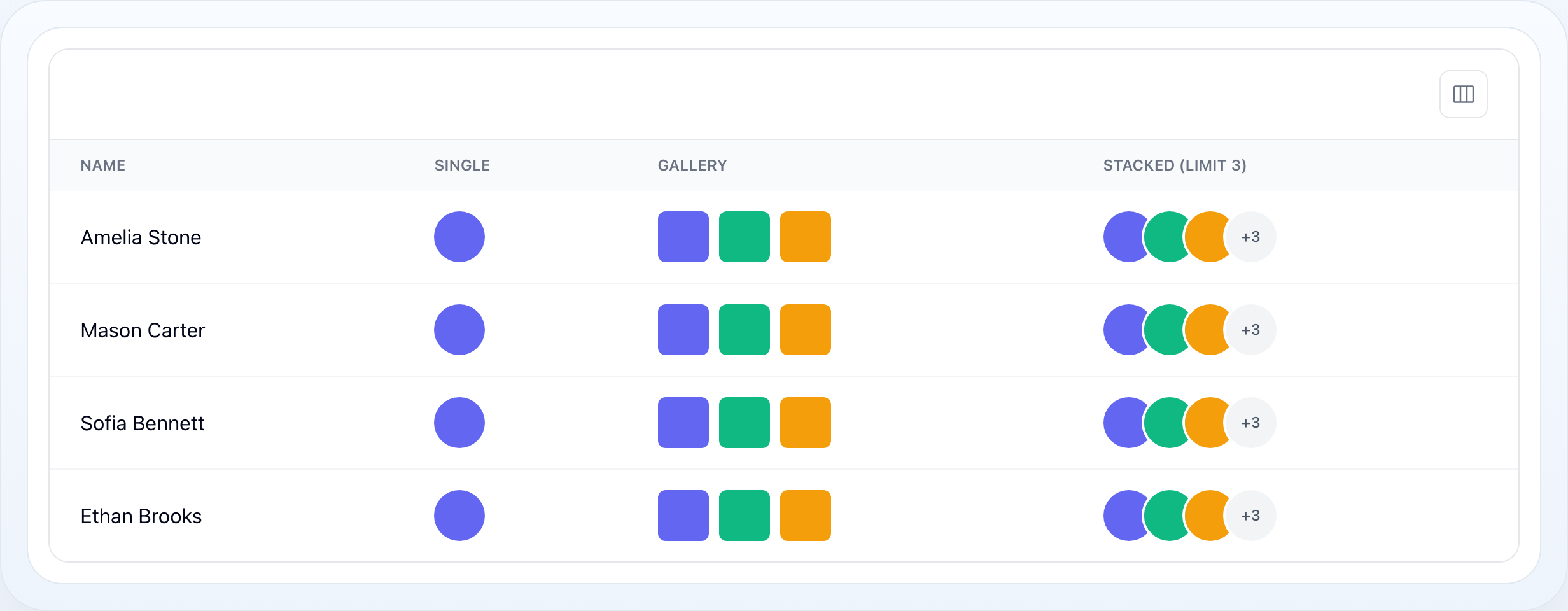
Images and avatars in a cell, and what an array of them renders as.
On this page
Displays images/avatars in table cells. An array state renders as a gallery.
use NyonCode\WireTable\Columns\ImageColumn;Basic Usage
ImageColumn::make('avatar_url') ->circular() ->size('md') ImageColumn::make('photo') ->size('lg') ->defaultImageUrl('/images/placeholder.png')Galleries
An array state (including a JSON array, as an array-cast column delivers it)
renders every image. stacked() overlaps them like avatars; stackLimit() caps
how many are drawn and summarises the rest as a +N chip.
ImageColumn::make('members') ->circular() ->stacked() // overlap, with a separating ring ->stackLimit(3) // draw 3, then "+N" for the rest (default 3)stackLimit() only applies to a stack — an unstacked gallery wraps and shows
everything.
Private Files
By default the column builds a plain Storage URL. For a file that is not publicly readable, ask the disk to sign a temporary one:
ImageColumn::make('scan') ->disk('s3') ->visibility('private') // sign a temporary URL ->urlExpiry(30) // minutes the signed URL stays valid (default 5)Not every driver can sign a URL — the
localdriver throws unless Laravel's temporary-url route is registered. The column falls back to the plain URL in that case, so one unsignable image cannot break the table.
ImageColumn API
->size(string|Closure $size) // scale: xs | sm | md | lg | xl | 2xl (default md)->circular(bool $circular = true) // rounded-full (otherwise rounded-md)->defaultImageUrl(?string $url) // fallback image when the value is empty->disk(?string $disk) // resolve relative paths via a Storage disk->ring(int $ring) // avatar ring width->stacked(bool $stacked = true) // overlap an array state like avatars->stackLimit(int $limit) // images drawn before the "+N" chip (default 3)->visibility(?string $visibility) // 'public' (default) or anything else => temporary URL->urlExpiry(int $minutes) // signed-url lifetime (default 5)
size()takes a named scale, not pixels — the scale maps to Tailwind width/height utilities (md→w-10 h-10). Its signature matches the canonicalHasSize::size(string|Closure)so the column stays usable; passing an unknown value falls back to themdscale.