Forms
Wire Forms
The form system: a schema declared in PHP, bound to a Livewire host or standalone, and what happens between a submit and a saved record.
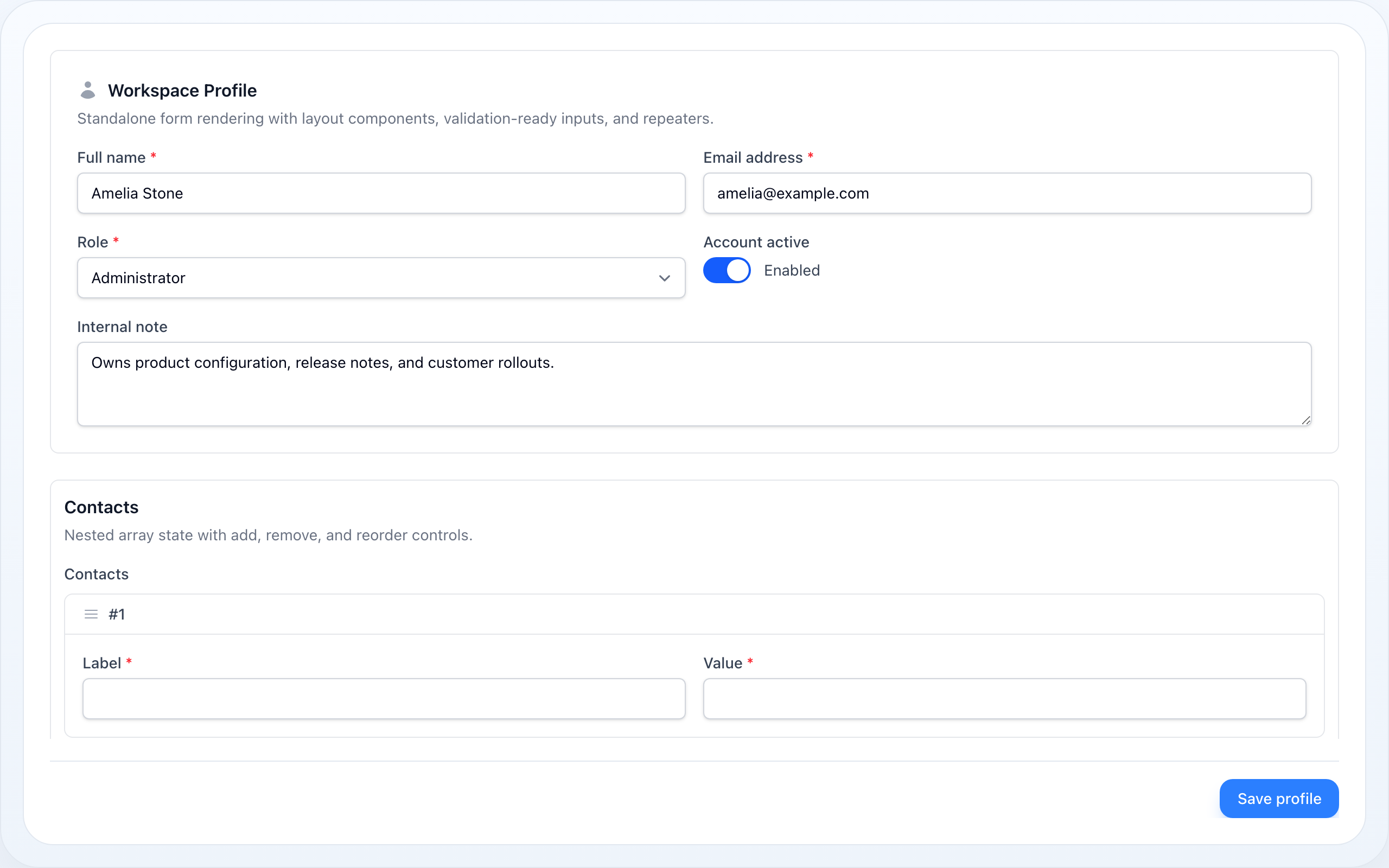
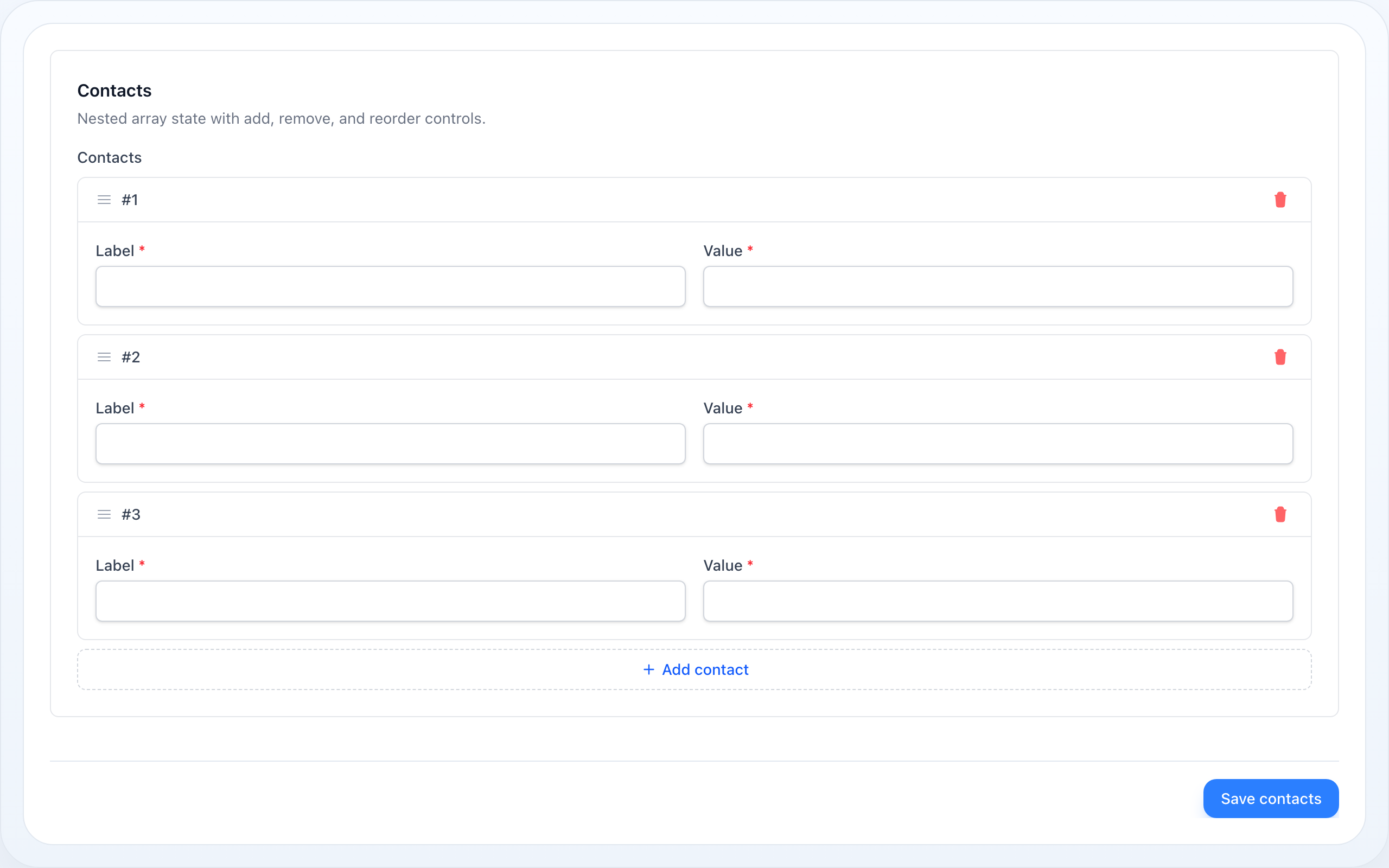
Nested rows with add, remove, and reorder controls.
On this page
- Installation
- How Forms Work
- Single Form
- Multi-Form
- Explicit Form Registration
- Model Modes
- Standalone Usage (without Livewire)
- Form API Reference
- Schema & State
- Model & Save
- Save Lifecycle Hooks
- Notifications
- Validation
- State
- Authorization
- Introspection
- Rendering
- Factory
- Livewire Binding
- WithForms Trait
- Warning Before Unsaved Input Is Lost
- Field Types
- Input Fields
- Layout Components
- Display Components
- Build Your Own
- Shared Field API
- Adjusting A Form You Do Not Own
Standalone form system for Laravel Livewire. Works independently or with Wire Table.
Need to display a record read-only instead of editing it? See Infolists — the same schema and layout, with display entries instead of input fields.
Installation
composer require nyoncode/wire-formsAdd to Tailwind content paths:
export default { content: [ // ...current app paths './vendor/nyoncode/wire-core/resources/views/**/*.blade.php', './vendor/nyoncode/wire-forms/resources/views/**/*.blade.php', ]}How Forms Work
Define a Form schema on your Livewire component, bind it to a state path, and render it with {{ $this->form }}.
Single Form
use NyonCode\WireForms\Forms\Form;use NyonCode\WireForms\Forms\WithForms;use NyonCode\WireForms\Components\TextInput; class CreateUser extends Component{ use WithForms; public ?array $data = []; public function form(Form $form): Form { return $form ->statePath('data') ->model(User::class) ->schema([ TextInput::make('name')->required(), TextInput::make('email')->email()->required(), ]) ->successMessage('User created'); } public function save(): void { $this->form->save(); }}<form wire:submit="save"> {{ $this->form }} <button type="submit">Create</button></form>Multi-Form
Methods ending with Form are auto-detected:
class UserSettings extends Component{ use WithForms; public array $profileData = []; public array $passwordData = []; public function profileForm(Form $form): Form { return $form ->statePath('profileData') ->model($this->user) ->schema([ TextInput::make('name')->required(), TextInput::make('bio'), ]); } public function passwordForm(Form $form): Form { return $form ->statePath('passwordData') ->schema([ TextInput::make('current_password')->password()->required(), TextInput::make('password')->password()->required()->rules(['confirmed']), TextInput::make('password_confirmation')->password()->required(), ]); } public function saveProfile(): void { $this->profileForm->save(); } public function savePassword(): void { $data = $this->passwordForm->validate(); $this->user->update(['password' => Hash::make($data['password'])]); }}<form wire:submit="saveProfile"> {{ $this->profileForm }} <button type="submit">Save Profile</button></form> <form wire:submit="savePassword"> {{ $this->passwordForm }} <button type="submit">Change Password</button></form>Explicit Form Registration
Alternative to auto-detection — return method names exactly as defined:
protected function getForms(): array{ return ['profileForm', 'passwordForm'];}Model Modes
// Create mode — Form::save() calls User::create($data)$form->model(User::class); // Edit mode — Form::save() calls $user->update($data)$form->model($user); // No model — save() throws, but validate() works$form->model(null);Introspection:
$form->isCreating(); // true when model is a class string$form->isEditing(); // true when model is an instance$form->getModel(); // Model instance or nullStandalone Usage (without Livewire)
Works for server-side validation and data processing:
$form = Form::make() ->schema([ TextInput::make('name')->required()->maxLength(255), TextInput::make('email')->email()->required(), ]) ->state(['name' => 'John', 'email' => 'john@example.com']); // Validate only$validated = $form->validate(); // throws ValidationException on failure // Validate + save$form->model(User::class)->save();Form API Reference
Schema & State
->schema(array $components) // field definitions->statePath(string $path) // Livewire property name for state->fill(array $data) // populate state->state(array $data) // alias for fill()->getState(): array // current state->getValidationRules(): array // collected rules->validate(): array // validate and return dataModel & Save
->model(string|Model|null $model) // Eloquent model (class for create, instance for edit)->save(): mixed // full save lifecycle->using(Closure $fn) // custom save callback (replaces default persist)->optimisticLock(?string $column = 'updated_at') // abort update if the record changed since fillSee Save Lifecycle → Optimistic Locking for the concurrent-edit guard.
Save Lifecycle Hooks
->mutateDataBeforeSave(Closure $fn) // fn(array $data): array — transform data before persist->beforeSave(Closure $fn) // fn(array $data): void — runs before persist->afterSave(Closure $fn) // fn(Model|mixed $record): void — runs after persistNotifications
->successMessage(string|Closure|null $msg) // custom success notification text; Closure receives $record->disableSuccessNotification() // no notification after saveValidation
->validationMessages(array $msgs) // custom validation messagesState
->disabled(bool $disabled = true) // make all fields read-onlyAuthorization
->authorize(bool $usePolicy = true) // enable model policy auto-resolution (create/update)->authorizeUsing(?Closure $callback) // fn(User $user, $record = null): bool — custom auth check->canSave(): bool // whether the current user may save->isReadOnly(): bool // true when authorization denies saveWhen ->authorize() is enabled the form becomes read-only (and hides the save button) if the current user lacks the create or update policy permission on the model.
Introspection
->isCreating(): bool // model is class string->isEditing(): bool // model is instance->getModel(): ?Model // current model instance->getFlatComponents(): array // all components (flat)->writableData(array $data): array // $data limited to what the form writes (no undeclared keys, no dehydrated(false))Rendering
->toHtml(): string // Blade output(string) $form // __toString()->nativeSubmit(bool $native = true) // render the fields for a browser submit, not Livewire->submitsNatively(): bool // which mode the fields are inNative submit
nativeSubmit() renders the fields for the browser's own form submission:
each carries name and value=old(…) instead of wire:model, and errors come
from the shared $errors bag. Use it where the endpoint is not yours — a
sign-in screen posting to Fortify's route is what it was built for.
The <form> element stays with you. The action, the @csrf and the submit
button are the page's decision, so the form object renders fields and nothing
around them:
<form method="POST" action="{{ route('login') }}"> @csrf {{ $credentials }} <button type="submit">{{ __('Sign in') }}</button></form>A field must declare it can do this, by implementing
Contracts\SupportsNativeSubmit. A schema containing one that does not throws
FormConfigurationException at render, naming the field — because a field bound
only by wire:model has no name, so the browser would post nothing for it and
the page would submit an empty value with no error anywhere. Anything needing a
round-trip mid-form cannot qualify: live() and reactive fields, a Select
searching on the server, FileUpload, Repeater. TextInput, Checkbox,
Hidden and OtpInput implement it — the fields the signed-out screens are
made of.
A checkbox binds differently from an input and deliberately so: it carries a
constant value="1" and answers with its presence, because an unticked box
posts no key at all. Its tick comes back from the last submission when there was
one — old() alone cannot tell "unticked" from "fresh page", so a box defaulted
on would silently re-tick itself after a user cleared it.
The mode is applied to the schema a form is about to render, after
form.configuring has run — so a field a plugin added is switched with the rest,
and one that cannot submit natively is refused whether it was declared or added.
Factory
Form::make() // static factory via containerLivewire Binding
->livewire(Component $component) // bind to Livewire componentWithForms Trait
The WithForms trait provides:
- Auto-detection — scans for methods ending in
Formand registers them - Lazy resolution — forms are only built when first accessed
- Caching — form instances are cached for the request lifecycle
- Magic property access —
$this->profileFormresolves the form
class MyComponent extends Component{ use WithForms; // Access via: // $this->form → calls form() method // $this->profileForm → calls profileForm() method // $this->settingsForm → calls settingsForm() method}Warning Before Unsaved Input Is Lost
wireUnsavedChanges — in the fields bundle every form page already loads — asks
before a reload, a closed tab or a wire:navigate link leaves a changed form
behind. Put it on the element that owns the form, with the form's state path and
the method that saves it:
<form wire:submit="save" x-data="wireUnsavedChanges({ path: 'data', method: 'save' })"> {{ $this->form }}</form>"Changed" is the form's state against what was last saved, not a key having been pressed: a value typed and put back is no change, and a picker or a rich editor that writes its state without a DOM event counts like any input. A save in flight holds the warning off — a create page redirects from inside its save — and only a successful one moves the baseline. The resource create and edit pages turn this on by themselves (Panels: Pages).
Field Types
Input Fields
- TextInput — text, email, password, numeric, tel, url
- Textarea — multi-line text
- Select — dropdown, searchable, multiple, relationship
- Checkbox — single checkbox
- CheckboxList — multi-checkbox group
- Radio — radio button group
- Toggle — on/off switch
- DateTimePicker — unified date/time/datetime
- TimePicker — time only, picked from a slot list
- ColorPicker — color selector
- FileUpload — file/image upload
- RichEditor — WYSIWYG editor
- Hidden — hidden field
Layout Components
Layout and schema components (Grid, Flex, Section, Fieldset, Tabs, Wizard, Callout, Empty State) live in the shared Schema section — the same vocabulary is reused by forms, infolists, and modals.
Display Components
- Placeholder — static text
- Alert — alert message
- Html — raw HTML
- ViewField — custom Blade view
Build Your Own
- Extending Forms — custom fields, display components, presets, and packaging
Shared Field API
Every field inherits:
->label(string|Closure $label)->helperText(string|Closure $text)->hint(string|Closure $hint)->hintIcon(string $icon)->required(bool|Closure $required = true)->hidden(bool|Closure $hidden = true)->visible(bool|Closure $visible = true)->disabled(bool|Closure $disabled = true)->size('sm'|'md'|'lg'|'xl')->columnSpan(int|string $span) // grid column span->default(mixed $value) // default value (create mode / absent keys)->defaultOnNull(bool $condition = true) // also fill the default over an edit-mode null->extraAttributes(array $attrs) // HTML attributes->live() // wire:model.live->debounce(int $ms = 500) // adds .debounce.{ms}ms to the binding->afterStateUpdated(Closure $callback) // react to value changes (auto-enables live)->rules(string|array $rules) // Laravel validation rules->unique(?string $table, ?string $column, bool $ignoreRecord = true, ?Closure $modifyRuleUsing) ->validationMessages(array $messages) // custom validation messages->formatStateUsing(Closure $fn) // fn ($state, $record) — shape a stored value into field state ->dehydrated(bool|Closure $condition = true) // false keeps the value out of the record->dehydrateStateUsing(Closure $fn) // fn ($state, $record) — shape the value on its way out formatStateUsing() runs as the form is filled, dehydrateStateUsing() as it is
saved, each after the field type's own transform. See
Save Lifecycle for what a field
writes, and Validation for unique().
visible(), hidden(), disabled() and afterStateUpdated() closures receive live state
accessors ($get, $set, $state). See Reactive Fields.
Adjusting A Form You Do Not Own
A form shipped by an installed module is built inside code the application does not have, so the three plugin hooks around it are the way in — one per stage, and they are not interchangeable:
| Hook | Runs | Reach for it to |
|---|---|---|
form.configuring |
once, when the schema becomes a config | add or remove a field |
form.filling |
when fill() binds values |
change what a field arrives holding |
form.saving |
after validation, before persistence | change what reaches the record |
$manager->hook(Hook::FormConfiguring, function (FormConfiguringPayload $payload) { $payload->schema = [...$payload->schema, TextInput::make('crm_id')]; return $payload;}, for: 'users');form.configuring is the counterpart of a table's table.composing: it runs at the
one place a schema becomes a config, and the config is memoized, so it fires once
per form rather than once per render. for: narrows the callback to one form — the
registered key of the resource a page shows, the host component's class, or the
model — and without it the callback runs for every form in the application.
See Hooks for the full list and Save Lifecycle for where the last two sit in the pipeline.